

Sustainable FlowSustainable Flow
Sustainable Flow is Flow Festival’s responsibility program developed to guarantee the environmental, social, and economic responsibility of Flow’s operations.
Environmental responsibility
Research and new environmental solutions
Flow Festival is known for its long-standing sustainability work reaching over a decade. In 2021, Flow Festival launched the Flow Impacts research project in cooperation with D-Mat, an expert company for a sustainable future, extensively examining the festival’s environmental effects. The project has been supported by Finland’s sustainable growth program, funded by the European Union’s NextGenerationEU financing.
The calculation tool created in the project was used to calculate the carbon footprint, measuring emissions, and material footprint, determining the consumption of natural resources, of Flow Festival 2022, 2023, 2024, and 2025. Based on the results, an even more holistic understanding of the environmental impacts of different aspects of Flow has been formed.
In 2025, Flow Festival took its first steps towards budgeting the consumption of natural resources and emissions as the first festival in Finland. The budgeting process involved the production team, which compiled consumption and emissions forecasts in spring 2025 based on known implementations and orders.
As predicted, Flow Festival’s consumption of natural resources and emissions increased compared to 2024. The growth in footprints was driven by necessary long-term investments such as the Balloon 360° venue sphere, new Flow letter signage at the main gate, the new Front Yard venue, groundworks required in the Hanasaari power plant area, as well as increased air travel by artists.
For production, the footprints were as follows:
Material footprint: 2,796 tonnes (2024: 2,531.90 tonnes)
Carbon footprint: 1,312 t CO2e (2024: 975 t CO2e)
Per day visit, the footprints were:
Material footprint: 30.2 kg (2024: 27.5 kg)
Carbon footprint: 14.3 kg CO2e (2024: 10.7 kg CO2e)
Flow Festival’s material footprint corresponds to the annual consumption of approximately 69 average Finns, and its carbon footprint to the annual emissions of around 137 average Finns.
When assessed per single day visit, Flow’s material footprint equals roughly one quarter of an average Finn’s daily consumption, while its carbon footprint is slightly below half of an average Finn’s daily emissions. A single day visit to Flow corresponds to approximately 80 kilometres of driving in a standard petrol-powered passenger car.
Based on the footprint calculations, Flow continues to reduce its environmental debt by donating to the Finnish Natural Heritage Foundation. The donation made for the 2025 event enables, on average, 5.5 hectares of Finnish old-growth forest to be permanently protected. Protecting old-growth forests helps fight the climate crisis and biodiversity loss.
Flow Festival strives to discover new solutions for producing more sustainable events. The budgeting and calculation tool for natural resources and ecological footprint created in the Flow Impacts research project enables the event industry to consider the environmental effects better already in the planning phase of events. The tool is currently being further developed in cooperation with Tieto.
Food and drink
Flow guides and educates its food vendors on ecological catering. In 2022, Flow dropped red meat and poultry entirely from its food selection, and in 2025, the festival further emphasised and increased the use of plant-based dishes in its restaurant services. All fish and seafood served in restaurants were domestically sourced, and all hot meals in the staff and artist catering were vegan.
The Flow Impacts research project proved that removing red meat and poultry from the food selection has significantly decreased Flow Festival’s climate impact. Food and drink contribute the third biggest source for carbon and material footprint, which is why reducing the environmental impact of food is so crucial when looking for ways to create more sustainable practices. In 2024, the carbon and material footprint for food decreased even more thanks to the increase in the amount of vegan dishes. In the future, Flow aims to become a completely vegan festival. Already 85 per cent of the dishes sold during the festival are either vegetarian or vegan, and for the last three years, almost half of the sold portions have been vegan. The transformation to being a completely vegan festival is supposed to be executed step by step, first by moving away from offering fish and other seafood.
Flow Festival’s visitors can fill up their water bottles at the festival’s water supply points. By drinking tap water, visitors can reduce plastic waste and carbon footprint. Additionally, Flow’s drink selection includes numerous responsibly produced beverages and several non-alcoholic drink options.
Recycling
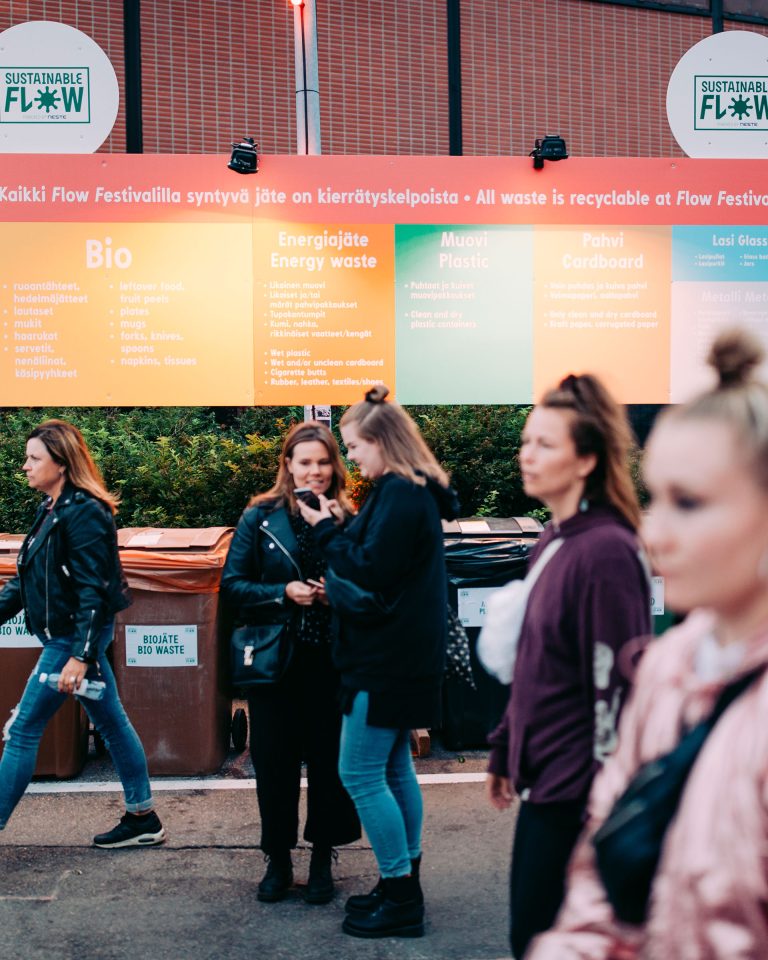
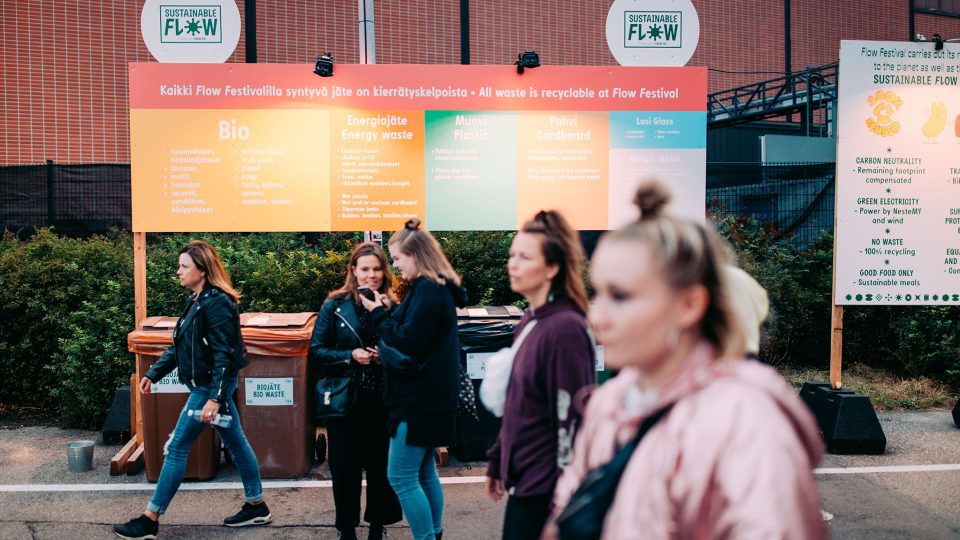
Flow sorts and recycles all waste produced during the festival, redirecting it to energy production or reusing waste materials. The goal is to further maximise the share of biowaste and other reusable waste products. Furthermore, all excess building materials possible are donated forward.
The festival seeks sustainable and durable solutions for all stages of event production. For example, we select furniture, fittings, and decorations that use recyclable, reusable, and long-lasting materials. We do our best to avoid new purchases, but when we must, we prefer recycled materials, local production and renewable materials.
In 2025, material handling and use across the festival were optimised, resulting in a nearly 30% reduction in waste. The total amount of waste generated was the lowest in the past ten years, despite the festival welcoming more than 20,000 additional visitors during the same period.
Energy production
Flow Festival utilises generators that provide most of the electricity needed for the festival, while simultaneously searching for new ways to intensify its energy planning to make it more ecological and economical. In the long term, the aim is to move away from generators and shift to fully using batteries and grid electricity.
Smart transportation
The Flow Impacts research determined that visitors’ arrival at the festival can amount to 70 % of the festival’s overall carbon and material footprints. We therefore encourage all visitors to arrive at Flow by bike, foot or public transport, as each transportation choice really matters.
Development and cooperation
Since 2012, Flow Festival has used the EcoCompass environmental management system. In 2025, the EcoCompass certificate was audited and updated.
For several years, we have also cooperated with the John Nurminen Foundation. Visitors have been able to support the Foundation with a donation of their choice when purchasing a festival ticket. In addition, invited guests can donate to the foundation when completing their accreditation for the festival. In 2025, the total donation sum was 4371 euros. The goal of the Foundation’s environmental projects is to improve the condition of the Baltic Sea with concrete measures that reduce the sea’s load and ecological risks.
Flow Festival has also begun its journey toward obtaining the Sustainable Travel Finland certificate, which promotes more sustainable tourism practices.
Social responsibility
Equality
Flow Festival promotes equality and diversity at every level. The festival’s program highlights diversity in gender, background, age and international representation, and recruitment processes aim to reflect a balanced gender distribution. Communications includes gender‑sensitive language and inclusive imagery. Multiculturalism is present throughout the festival, for example, in the food program, and Flow has supported social integration through collaborations, such as with Startup Refugees.
Flow is committed to fair and equal work opportunities by offering paid internships, challenging traditional gendered assumptions about job roles, and ensuring transparency in compensation. All employees, volunteers and subcontractors are introduced to the Sustainable Flow guidelines and the Code of Conduct, and the festival’s responsibility work is led by a dedicated sustainability producer.
We continuously strive to develop and carry out equality even better and happily accept any ideas you may have regarding the matter. You can approach us by emailing office AT flowfestival.com.
Diversity
Flow participates in the European Keychange initiative, which aims to improve the standing of underrepresented genders in the music industry. Among other things, Keychange participants commit to choosing an equal amount of male and female, trans and non-binary performers by 2022. Flow accomplished the goal in advance: in 2019, 65%, and in 2025, around 55% of the groups that performed at Flow had women, trans, or non-binary members.
Societal responsibility
Flow works in professional, ethical, and responsible manners and in a sustainable way for the environment and society. We cooperate and converse openly with the organisations, authorities, and other officials in our field of business.
Flow utilises Helsinki’s Compass for Social Responsibility at Events for reviewing the festival’s social responsibility. In addition, the festival donates 60 complimentary tickets to be distributed to people in low-income situations through the City of Helsinki’s Social Services and Health Care Division, as well as 60 complimentary tickets for clients of the city’s youth work and substance abuse services.
Accessibility
Flow Festival aims to make the event as accessible and inclusive as possible for all visitors, regardless of their abilities. The festival area has been planned and developed in collaboration with accessibility expert Riesa Consultative.
Riesa has, for instance, trained Flow’s staff to meet different kinds of visitors sensitively and to provide appropriate support in customer service situations. Accessibility is considered throughout the entire service path from arrival and signage to service points and viewing areas, so that everyone can enjoy the festival safely and in their own way.
The EU Disability Card and Toilet Card (Vessapassi) can be used at Flow Festival. Assistants can always enter Flow Festival free of charge with the assisted person.
We continually develop Flow’s accessibility and welcome improvement suggestions via email to office AT flowfestival.com. We are updating accessibility information for this year’s festival and will add it here later in the spring.
Safety
Flow is known as a safe festival, but we are aware of the challenges related to the safety of a large public event. Together with the festival audience, subcontractors, and other stakeholders, we aim to create an event where everyone can participate safely and feel comfortable. Securitas Events Oy manages the security and crowd control in the area. A harassment contact person works in the area during the festival and is at the disposal of all festival visitors, employees and artists.
We conduct an annual visitor survey, which in 2025 received responses from more than 7,800 festival attendees. In the 2025 survey, respondents were asked to rate Flow’s overall safety and the performance of our security personnel on a scale from 1 to 5. The average overall safety rating was 4.4, and our security staff received an average rating of 4.2. First aid services were rated at an average of 4.7, and the harassment contact persons’ services at 4.3 (responses provided only by those who used these services).
We strive to develop and improve the festival’s safety continuously – please send us your feedback to office AT flowfestival.com.
Economic responsibility
An economically sustainable event
Flow Festival does long-term and systematic work to operate financially sustainably. For the festival’s operation to be economically sustainable, it must also be financially profitable.
In addition, we are constantly working to develop the event industry to be more professional and sustainable. We employ a permanent team of ten people, hundreds of seasonal workers in the events industry, numerous interns and thousands of people through cooperation and subcontracting chains. We comply with statutory employer obligations and remuneration following industry salary recommendations. We also work closely with other operators in the field to develop operating models. We invest in responsibility in procurement and services, and we favour local operators in, for example, accommodation, restaurants and other areas of production.
Furthermore, Flow Festival works constantly to promote more sustainable practices for the event industry by offering the budgeting tool it developed with D-Mat and Tietoevry for other events to use.